Curriculum Structure
The LAU Gilbert and Rose-Marie Chagoury School of Medicine offers a four-year, integrated, student-centered, and competency-based undergraduate medical education program. The curriculum integrates biomedical, clinical, behavioral, social, and population health sciences, while progressively developing the knowledge, skills, professional identity, and competencies required of a modern physician.
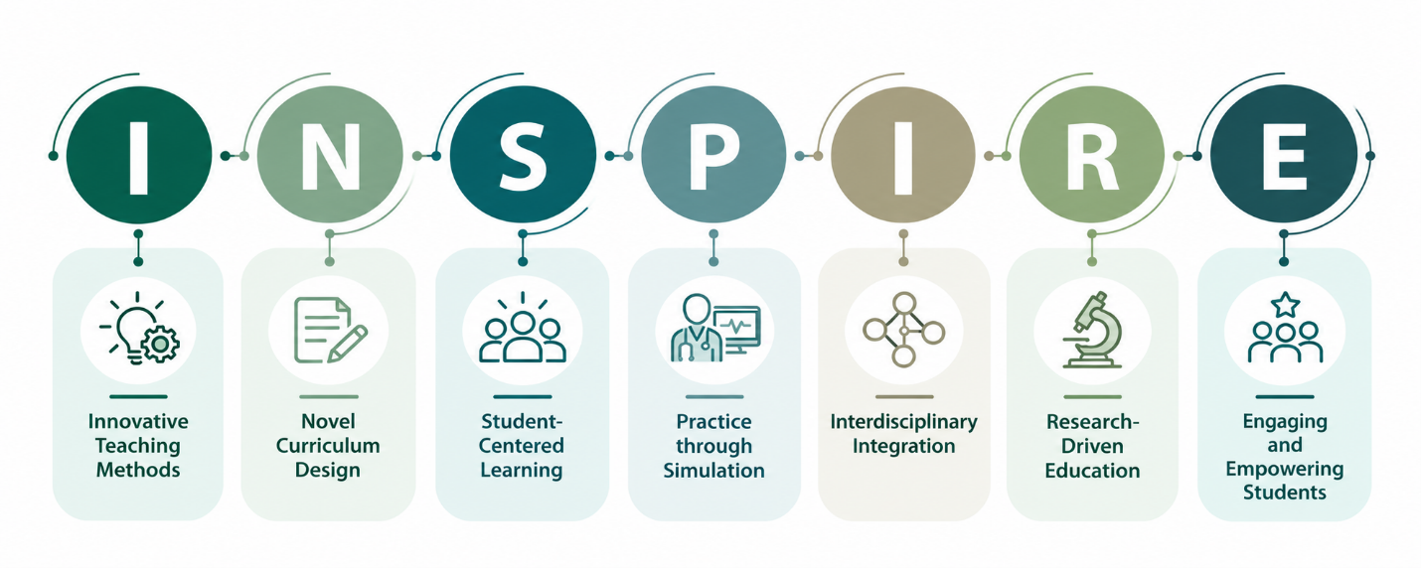
The INSPIRE Curriculum provides the framework for the School of Medicine educational experience. INSPIRE stands for:
The Med I and Med II years integrate biomedical and clinical sciences through a sequence of foundational and organ-system modules. Rather than learning disciplines in isolation, students encounter concepts from multiple scientific and clinical perspectives and apply their knowledge to authentic clinical and community-based problems. Learning is supported by case-based and interactive approaches, simulation, technology-enhanced education, cadaveric and Anatomage-based learning, and other active learning strategies. The Becoming a Doctor longitudinal experience begins early in medical school and supports the progressive development of students’ professional identity and understanding of the physician’s role.
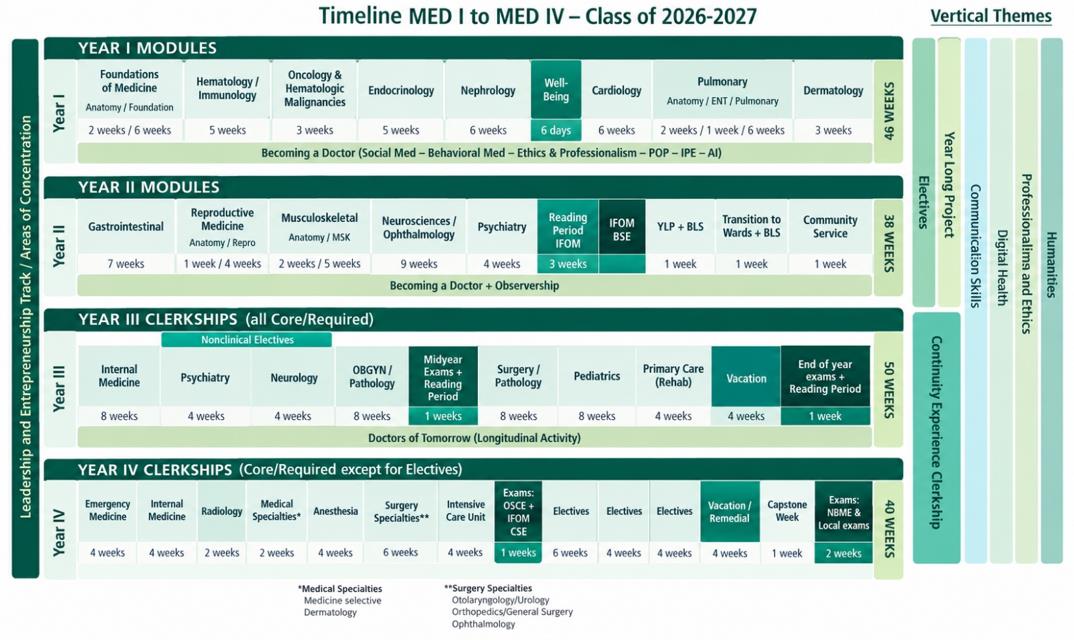
The Med III and Med IV years provide progressively immersive clinical experiences through core clerkships, longitudinal learning, and elective opportunities. Students learn within authentic healthcare environments while continuing to develop clinical reasoning, communication, professionalism, patient safety, teamwork, and evidence-informed decision-making. A longitudinal Continuity Experience enables students to follow patients or families over time, connecting clinical care with the broader determinants of health and the realities of home and community life. In Med IV, students complete 14 weeks of clinical electives, providing opportunities to personalize their learning through intramural or extramural experiences in Lebanon and internationally.
A defining feature of the INSPIRE Curriculum is its longitudinal and vertically integrated curriculum themes. Rather than being confined to individual courses, themes essential to the development of future physicians are intentionally reinforced across multiple years and learning environments. These include patient safety, research, ethics, professionalism, communication, digital health and artificial intelligence, leadership, and community engagement. Students revisit and apply these concepts with increasing depth and complexity as they progress from classroom learning to simulation and ultimately to patient care.
The curriculum also provides opportunities for students to shape and enrich their learning journey. In med III, longitudinal non-clinical electives include areas such as Digital Health and AI, Community Engagement, and Lifestyle Medicine, while additional opportunities in disaster medicine, point-of-care ultrasound, applied genetic medicine, and antimicrobial resistance allow students to explore emerging areas of medicine. A longitudinal Leadership and Entrepreneurship track further develops skills needed to lead innovation and contribute to the transformation of healthcare.
The curriculum reflects the School of Medicine’s commitment to social accountability. Students engage with the health needs of individuals, families, and communities and develop an understanding of health that extends beyond the biomedical model to include disability, social determinants of health, prevention, health promotion, and equitable access to care. Community-based experiences and engagement with diverse patient populations reinforces students’ responsibility to the communities they serve.
The INSPIRE Curriculum thus provides a progressive continuum from learning to practice: from foundational science and simulated learning, to authentic clinical experiences, research, community engagement, and increasingly independent professional practice. Through this integrated structure, the School of Medicine prepares graduates to be clinically competent, compassionate, socially accountable, digitally and AI literate, adaptable, reflective, and prepared to lead and innovate in the healthcare systems of the future.
Explore the Curriculum by Year
Current LAU Gilbert and Rose Marie Chagoury School of Medicine students may access detailed schedules, learning objectives, and module and rotation guides through Blackboard. Students interested in Med IV elective opportunities may visit the Med IV Electives page.
Explore the four-year curriculum below to view the progression from foundational and integrated learning in Med I and Med II to core clinical clerkships and advanced clinical experiences in Med III and Med IV.
Med I: Foundational & Integrated Modules
| Foundations of Medicine | 8 Weeks |
| Hematology & Immunology | 5 Weeks |
| Oncology& Hematologic Malignancies | 3 Weeks |
| Endocrinology | 5 Weeks |
| Nephrology | 6 Weeks |
| Well Being | 6 Days |
| Cardiology | 6 Weeks |
Pulmonary
|
9 Weeks |
| Dermatology | 3 Weeks |
Med II: Integrated Modules & Transition to Clinical Training
| Gastrointestinal | 7 Weeks |
|
Reproductive Medicine
|
5 Weeks |
Musculoskeletal
|
7 Weeks |
| Neurosciences & Ophthalmology | 9 Weeks |
| Psychiatry | 4 Weeks |
| Year-Long Project (YLP) & Basic Life Support (BLS) | 1 Week |
| Transition to the Wards & Basic Life Support (BLS) | 1 Week |
| Community Service | 1 Week |
Med III: Core Clinical Clerkships (All core required)
| Internal Medicine | 8 Weeks |
| Surgery/Pathology | 8 Weeks |
| Pediatrics | 8 Weeks |
| Obstetrics & Gynecology (OB/GYN)/ Pathology | 8 Weeks |
| Psychiatry | 4 Weeks |
| Primary Care | 4 Weeks |
| Neurology | 4 Weeks |
Med IV: Advanced Clinical Training & Electives (Core/Required except for electives)
| Surgery Specialties | 6 Weeks |
| Internal Medicine | 4 Weeks |
| Anesthesiology & Rehabilitation | 4 Weeks |
| Emergency Medicine | 4 Weeks |
| Intensive Care Unit | 4 Weeks |
| Radiology | 2 Weeks |
| Medical Specialties | 2 Weeks |
| Capstone Week | 1 Week |
| Electives | 14 Weeks |
Longitudinal and Vertically Integrated Themes
Complementing the year-specific modules and clerkships, key themes and learning experiences extend longitudinally across the curriculum and are reinforced with increasing depth and complexity as students progress through the MD program.